ASKY strengthens pan-African network with eighth Boeing 737 MAX 8 and prepares 787 long-haul leap
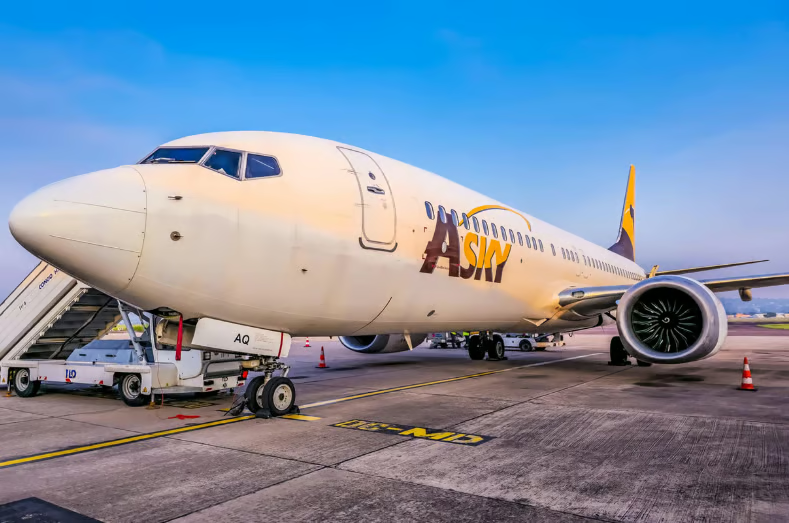
West Africa’s aviation momentum continues to gather pace as ASKY Airlines, the Lomé-based pan-African carrier, prepares to welcome its eighth Boeing 737 MAX 8 into the fleet. The aircraft has recently completed a verification flight in Ireland ahead of its formal delivery, marking yet another significant chapter in the airline’s ambitious modernisation and growth strategy. For the African travel trade, this development is a clear sign that ASKY is intent on cementing its position as a leading regional player and a credible long-term partner for tour operators, corporate buyers and travel sellers across the continent.
The arrival of the new 737 MAX 8 reflects a sustained effort by ASKY to refresh and expand its fleet with one of the most efficient narrowbody aircraft available in commercial aviation today. The Boeing 737 MAX 8 is widely valued for its lower fuel consumption, reduced emissions, extended range and modern cabin comfort, qualities that align perfectly with the operational realities of intra-African flying. With each new addition, ASKY strengthens its ability to deliver reliable connections across the continent while reducing its carbon footprint in line with growing global expectations around sustainable aviation. The carrier has been progressively phasing out older Boeing 737 NG aircraft in favour of these newer-generation jets, a strategic move that places it among the more forward-looking operators on the continent.
Equally exciting for African travel professionals is the airline’s announced plan to introduce Boeing 787 Dreamliner widebody aircraft into service from 2027, paving the way for long-anticipated intercontinental services. This represents a transformative shift for ASKY, which has historically focused its energies on regional connectivity within Africa. The introduction of the Dreamliner will allow the carrier to deploy services on long-haul routes, potentially linking Lomé directly to key markets in Europe, North America, Asia or the Middle East. Such a development would significantly enhance West Africa’s global air access and reduce the dependence of regional travellers on transit hubs in Europe, the Gulf or Addis Ababa.
ASKY’s continued growth must be understood within the broader context of its strategic positioning. The carrier operates from its base at Gnassingbé Eyadéma International Airport in Lomé, which has steadily been groomed as a regional aviation hub serving more than two dozen African countries. The airline already provides connectivity across major West and Central African capitals including Lagos, Accra, Abidjan, Dakar, Bamako, Cotonou, Niamey, Ouagadougou and Kinshasa, among others. As the fleet expands, the airline is well positioned to add new destinations, increase frequencies on high-demand routes and improve the overall passenger experience for both leisure and business travellers.
The development also speaks to the deepening relationship between ASKY and Ethiopian Airlines, its strategic shareholder and long-standing technical partner. The partnership has played a central role in ASKY’s fleet renewal programme, with Ethiopian Airlines providing critical operational, technical and managerial support over the years. This intra-African collaboration stands as a powerful example of how cooperation between African aviation operators can deliver tangible benefits, including improved network reach, better aircraft utilisation and shared expertise. As more African carriers explore similar partnership models, the ASKY-Ethiopian relationship offers a working template worth emulating.
For the African travel trade, the implications of ASKY’s expansion are wide-ranging. Tour operators developing multi-destination West African itineraries can look forward to more flexible schedules and richer routing options. Corporate travel managers serving multinational clients with operations across the region will benefit from improved frequency and reliability. The airline’s growing fleet also positions it well to participate in major upcoming sporting, business and cultural events on the continent, where seamless intra-African mobility is increasingly essential.
Looking ahead, ASKY’s planned introduction of widebody operations in 2027 promises to redefine the carrier’s strategic profile. Should the 787 deployment proceed as envisaged, West African travellers will gain new direct gateways to the world, while inbound tourism flows into the region could receive a meaningful boost. The combination of a modernised narrowbody fleet, an expanding network and an emerging long-haul ambition signals that ASKY is no longer just a regional connector but a serious contender on the continental and intercontinental stage. The African travel community should pay close attention, as the airline’s next moves are likely to shape the future contours of West African aviation for years to come.
Originally Published at travelnews.africa